
Is Bitcoin MONEY?
Past performance is no guarantee of future returns;
this is NOT investment advice and is meant to be educational in nature.
“Money is not an invention of the state. It is not the product of a legislative act. Even the sanction of political authority is not necessary for its existence. Certain commodities came to be money quite naturally, as the result of economic relationships that were independent of the power of the state.”
— Carl Menger
is Bitcoin money, a confirmed, immutable, and decentralized yes, and thanks in part to the Fed?...
Economists agree that money must be durable, portable, divisible, uniform, scarce, and widely accepted.
Is Bitcoin money? I believe largely yes: it’s all six of those, but only partially acceptable, as it’s not widely used for everyday transactions. Based on these characteristics, bitcoin does serve as a form of money, albeit an operationally inefficient one as a day-to-day medium of exchange.
The total value of all Bitcoin today is around $1.77 trillion (01/27/2026). Where does the perceived value of this inefficient, largely impractical asset come from? At its core, it’s simple: over the past decades, buyers have far outnumbered sellers. But why?
On January 3, 2009, the bitcoin network was created when Nakamoto mined the starting block of the chain, known as the genesis block. The genesis block also contained a hidden message in its code:
"The Times 03/Jan/2009 Chancellor on brink of second bailout for banks"
The Great Recession began in late 2007, and by 2008 TARP was underway. By 2009, markets had collapsed, liquidity froze, and banks were failing. The government’s response and central banks worldwide was massive intervention, printing trillions in currency to stabilize banks, support the economy, combat deflation, and prop up struggling governments. Just over a decade later, JPOW said, “Hold my N95.”
Here is a chart of the Federal Reserve’s balance sheet, which has expanded dramatically from 2008 to today, an unprecedented surge in monetary policy...
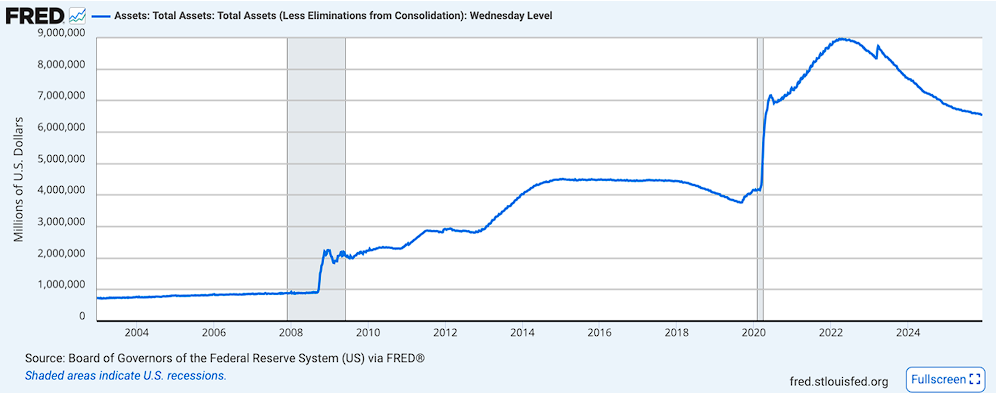
...printing money to mitigate and or eliminate the widespread collapse of the entire global economic system... the Fed over the last 20 years and on two separate occasions...
and the rest of the world’s central banks, did the same...

…by printing trillions out of thin air, central banks around the globe diluted the purchasing power of their own currencies, eroding their value with each new round of monetary expansion. In doing so, they violated one of the most essential principles of any valid currency, scarcity.
and the result?...
...Bitcoin… I believe a newly minted format to serve as a medium of exchange, a volatile store of value, and a unit of account. It was developed, out of necessity, by the free-market system trying to protect itself from the erosion of currency value caused by relentless monetary expansion and centralized intervention.
and its future?...
“If” my theory holds true, that cryptocurrencies arose as a free-market response to central bank policy and currency devaluation, then Bitcoin’s long-term tailwinds likely remain strong. The main risks will be political, emerging when crypto challenges national currencies, especially in first-world nations.
Summary:
Bitcoin meets the core characteristics of money and was born as a market-driven response to the failure of central banks to preserve currency value. While its day-to-day utility and future price remain uncertain, its creation reflects a structural hedge against monetary expansion, and the long-term forces that gave rise to it may continue to support its relevance.
Schedule a free, 30-minute, no-pressure, NO BS, introductory financial planning consultation with Fountainhead Wealth Planning.
Brett F. Anderson, CFP® CIMA® CAIA® M.S. Econ
Do you have questions? I'd like to help. Please call me at (864) 790-3385.