
The Volcker Fed
Past performance is no guarantee of future returns;
this is NOT investment advice and is meant to be educational in nature.
“I called Paul Volcker, who is raising the discount rate.
This will hurt us politically, but I think it’s the right thing to do”
— Jimmy Carter
and all thanks, to Jimmy Carter...
In my opinion, one of the most politically courageous and economically consequential decisions of the last half-century was President Jimmy Carter’s choice to replace G. William Miller as Federal Reserve Chair. Carter understood exactly what the economic fallout would be, yet he chose the harder, less politically expedient path by appointing Paul Volcker, a known policy hawk committed to breaking inflation.
The stagflationary 1970s, especially at decade’s end, were an economic quagmire. A weakening economy collided with an oil shock, creating an environment defined by the rare combination of high inflation and stagnant or slowing growth. Stagflation shattered the existing Keynesian economics frameworks. Traditional models assumed an inverse relationship between inflation and unemployment; the 1970s delivered both at once.
From a Federal Reserve policy standpoint, this presented a dilemma without precedent. The Fed raises rates to cool inflation and lowers them to stimulate weak demand, but stagflation required doing both at the same time. It was a contradiction no demand-only model could resolve.
Faced with this reality, the Carter administration understood that restoring economic stability would require a painful act. He confronted two stark choices: allow interest rates to rise sharply to break inflation, knowing it would inflict even deeper economic pain, or maintain the status quo and risk letting inflation accelerate further. Carter took unselfish and decisive action, fully aware that the consequence would be a deliberate and severe slowing of the economy and likely the end of his own political future.
On August 6, 1979, Paul Volcker was sworn in as Chair of the Federal Reserve board. He left no stone unturned during his war on inflation:
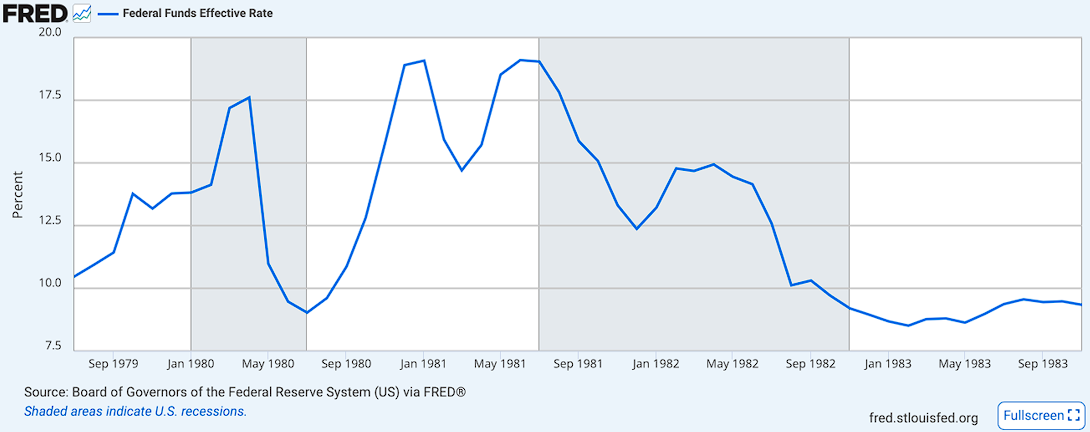
The Volcker Shock: Volcker’s Fed rose Interest rates from ~10% to almost 20% over the next two years:
and the result?...
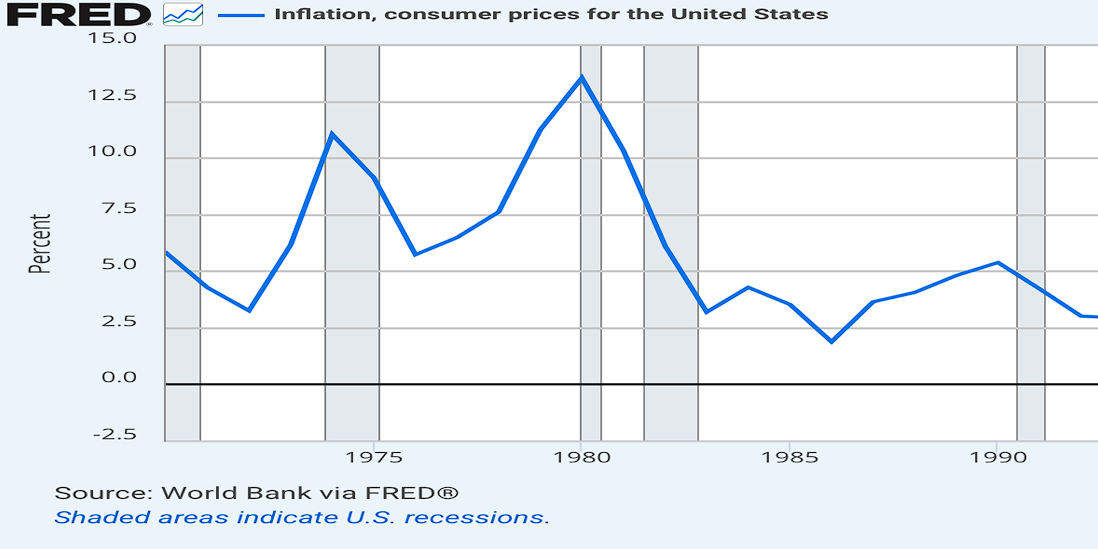
President Jimmy Carter’s decision to appoint Paul Volcker as Federal Reserve Chair triggered a deep economic recession but dismantled an inflationary regime that had gripped the country for over a decade. The Volcker Shock worked faster than its inflationary target, and politically, it hit Carter hard he lost the 1980 election to Ronald Reagan.
Unfortunately, it was too early for the country to fully appreciate the significance of these actions. Economically, Carter made the right decision: by confronting entrenched inflation, he set the stage for four decades of relative stability. Volcker’s policies anchored inflation expectations, enabled steadily falling interest rates, fostered long-term growth in equities and credit markets, strengthened the U.S. dollar globally, and established the framework for a modern, independent Federal Reserve whose decisions would guide the nation’s financial and macroeconomic stability for decades to come.
Volcker being impartial to political implications took drastic measures to clear a broken economic system of distortions and abnormalities, thus setting the stage, for the greatest era of economic prosperity this world has ever seen...
...all thanks, to Jimmy Carter...
Happy to talk politics, economics, markets, or financial planning with you...
Schedule a free, 30-minute, no-pressure, NO BS, introductory financial planning consultation with Fountainhead Wealth Planning.
Brett F. Anderson, CFP® CIMA® CAIA® M.S. Econ
Do you have questions? I'd like to help. Please call me at (864) 790-3385.